Maps are as much a impression of space as they are a claiming of space, rendering to ink and paper whole swaths of peoples, cultures, and histories, so that it eventually seems that the whole world revolves not around the sun, but around the delineations of empire. The more the map is imbued with scripts and colors and markings, the more possibilities for those inhabiting each plane are bled dry. Spaces become words, and words alter the realities of those caught in between the strikes of a pen—but they are not alone. The reality of the mapmaker, or the reader of maps, is glossed over, too:
“What was the place like before it was named? . . . Even as we look towards the horizon or turn away down fixed routes, our gaze sees through the space of history, as if it was never there. In its place, nostalgia for the past, cloudy time, the repetition of facts. The fact that where we stand and how we go is history: this we do not see.”
(Carter 375)
Not only does the colonial presence distort the narrative of its colonized subjects, but it also distorts its own sense of past, present and future. The Western empire was jettisoned by map-making—it shaped reality into something malleable, a way of being that magnetized around the creation of cultural fictions. And when those cultural fictions were taken for granted as fact by both conqueror and conquered, it was the submerged realities that became hued with the strangeness of fiction.
Before its transition under British colonization, the territories of Burma were largely ruled by a series of feudal kings and inhabited by un-self-consciously pluralistic populations. The name “Burma” is derived from the Bamar (Burman), the majority ethnic population (of many others that have now been ‘designated’ as distinct groups) inhabiting the Burmese region. Burma was first named as a Province of British India in 1885, following three Anglo-Burmese wars. This ancillary naming paved the way for the nation-ness of Burma, as we know it on the maps. Initially, the triage of wars was catalyzed by the expansions of the Konbaung Dynasty—the last indigenous dynasty of Burma—into territories bordering the Province of British India in 1824. Eventually the British discovered how rich in teak and other natural resources the Konbaung Dynasty’s territories were, and waged a second and third war in order to acquire them as province, ultimately ousting indigenous leadership. But, let the maps show, it was a ‘necessary’ acquisition.

An ancient temple crops of from the arid plains of Bagan, its bricks awash in afternoon sun. Hundreds of similar temples populate Bagan, which served as the capital of the Pagan Kingdom from the 9th-13th centuries.
The third and final Anglo-Burmese war in 1885 was rationalized as a proactive rebuttal to potential French influence in the disputed territory. In short, Burma was acquired as another canvas for inscription and exploitation by the British Empire, commandeered to minimize its risk of being counter-scripted. The wars with Burma and its eventual mapping into a British province was thus rationalized as an acquisition of not only territory, but narrative. The excerpt below is written by a British military official serving in Burma, and is part of an 1827 rationale for the Anglo-Burmese wars addressed to King George IV:
“The impression which has endeavoured to be fixed on the minds of the public has been, that the Burmese were the sole aggressors—that the Government of India having long born insult and aggression without retaliation, and with great forbearance, were at length compelled to resort to arms in support or vindication of the honour of the British character—to repel invasion, to seek redress for past injuries, to obtain security for the future, and to establish a peace on a solid and permanent basis.”
(Captain W. White, Preface, “A Political History of the Extraordinary Events Which Led to The Burmese War”, 1827)
Note the distortion of the past, present and future as indicated by Captain White: he refers to “past injuries”, a notion of a “secure” future, and the urgent present-tense need to “repel invasion.” But what injury, what security, what invasion? The colonial administration in India needed to craft a worldview that mapped their territories as naturally given rights, therefore always under threat of invasion by alien ‘Others.’ The colonial administration also needed to project a future in which the boons of Empire are of such value that their loss would mean an ending to all that is ‘honourable.’ Lastly, a past ‘record’ of injury needed to be conjured in order to vindicate any injury on Burmans the British might be led to inflict. Flip the gilded coin and this is the submerged reality: the territories of the British empire were gained through invasion; the future of the British empire was being built through destroying, rebuilding, then threatening the security of others; and the past wrongs inflicted on the British empire were in themselves attempts at self-defense and retaliation.
The British had mapped their own image, insecurities, and desires onto the spaces and bodies of their colonized territories. As such, mapping became a form of narrative—in a way, it was a preliminary step towards and reference for the creation of a history. Like the (re)visionary process of map-writing,
“Neither objectified nor praised as creative, narration opens a site of revised time, a space that makes subversion and revision possible . . . narratives open an in-between”
(Knaller 109)
Narrativity creates a gap that allows for the distortion of the past through the words and mappings of the writer. It attempts to render a false sense of linearity at the same time as it detaches itself to operate in a plane removed from past, present and future. In writing histories, narrativity “assumes a gap to exist between the silent opacity of the ‘reality’ it seeks to express and the place where it produces its own speech, protected by the distance established between itself and its object” (de Certeau 3). In other words, narrativity as history-making device, functions to reduce time and space into an object of not only inquiry but revision. In this sense, colonial histories reduce the bodies of the colonized into objects of another culture’s myth—the generations of those bodies are therefore key in both anchoring the myth, as much as the myth is key in shackling generations of bodies to an excised spatial and temporal reality. The colonized were unmapped—removed from their histories—so they could be remapped onto another’s.
Look at this picture from Mandalay Hill.
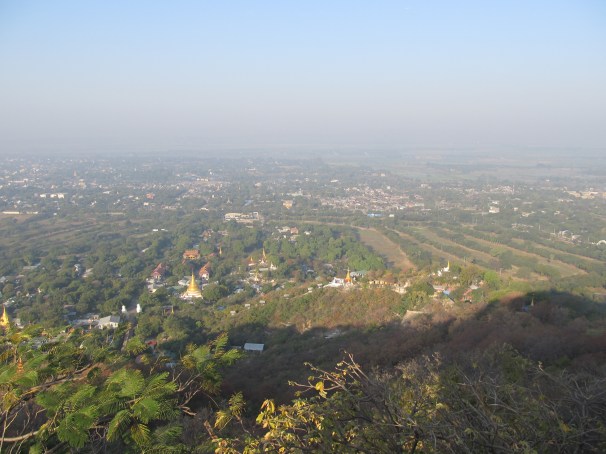
Haze tinges an expanse of ancient pagodas and colonial structures, diminishing the horizon’s absoluteness like memory’s miring of time and space.
It was taken by my brother Jason, during a 2014 trip to Burma with our grandmother Nunu. It had been her first time back to the country since her family was forced to flee by Ne Win’s military coup in 1962. I want you to step into this image as you listen to Jason recount climbing up Mandalay Hill with Nunu, slowly and methodically, taking in the blinking constellations of pagodas, interlaced with brick, colonial administrative buildings, dotting a landscape that appears gold in its arid haze. From that haze, Nunu begins to conjure a memory of the heavy British and Japanese artillery that took place from Mandalay Hill, considered a strategic military foothold during WWII. The sacred lineage of Mandalay Hill, which had been a destination for two centuries of Buddhist pilgrimages, is thus over-layed with a new lineage, one of narrative conquest and warfare. I want you to adopt a distanced view of history. Envision the layers of space as they operate over and against one another—pitting cultures, legacies and memories against one another—for this is what really happens within the forged gap between narrativization and object.
As Jason recounts, Mandalay Hill “really was the only piece of topography around . . . a really prominent feature on the landscape.” I also want you to consider what it means to be a prominent piece of topography—not only literally, as geographical feature—but also as a human feature in a narrative, a history, the map of another empire. Nunu’s story of WWII bombing captures an unlinking from one narrative and a suturing into another, in which she is bestowed and “unreal but meaningful relation to the social formations in which they are indentured to live out their lives and realize their destinies as social subjects” (White x). As you listen to the stories that interrupt the narrative of Burma, you might be swayed to perceive history and narrative not as linear but kaleidoscopic, a series of intersections, over-writings, submersions, and re-emergences. This sort of history operates from the gap between the creators of history and its objects, and therefore brings to light the ways in which various subjectivities are welded onto the maps, pages, and bodies of the colonized through the process of history-writing. Nunu’s family’s seat within the British administration, as you will come to hear, fashioned them a unique set of paths to take as they both engaged with and endured the persistent creep of Western empire.
 A Mirage Named Myanmar
Recent Comments