
Jason and Nunu pause to take in the hazy expanses of Mandalay and beyond as they climb the steps of its sacred hill. Mandalay Hill, 2013.
What if the tracings of exile, of excision from the maps, became a nation unto itself? Perhaps longing for nationhood, does not have to mean a longing for geospatially map-able borders. Perhaps it could be more of a “lament for the necessary and regrettable insistence of nation-forming, in which the [dreamer] proclaims his identity with a country whose artificiality and exclusiveness have driven him into a kind of exile—a simultaneous recognition of nationhood and an alienation from it” (Brennan 174); and not only that, but a celebration and inhabiting of exile? If one acknowledges the arbitrariness of the lines drawn on a map, shaping nations from endless expanses of soil and sand and water, then one might also be able to understand nation as something conjured. But, rather than drawing out the borders of territories with strokes of ink and then allowing the flow of bodies and commodities accordingly, perhaps borders can be shifted, traversed, and impressed into existence prior to the mapping. And maybe that has already happened.
My family was forced into exile a second time, following Ne-Win’s military coup of 1962. Despite the fact that their expulsion was a result of their Karen allegiances, it was the invisible, global networks of nonprofit organizations and alliances that allowed my family to not only survive Burma’s military regime and their escape into Thailand, but also to make it into the states employed. And, if you think of each node of aid my family received as they journeyed, first through the jungles of the Thai-Burma border, then across oceans to the United States, you might begin to see faint constellations of resistance—undetectable by map, but revived and reinvigorated through story: “Driven by the imperatives of protecting a sense of self and community in a distant land, exile communities are often the source of strident uncompromising rhetoric” (South 62). The story of my family’s escape from Burma and eventual rooting within the West underscores the importance not only of “exile communities” but the culpability of organizations and philosophies that might have catalyzed the need for exile. You will hear of the ways in which the American Baptist organizations—once the origin of the Karens’ ethnic cleaving—initiated a web of responses that ensured their safe re-installment once again, sort of but not quite, within Western empire. I’m not saying this absolves the colonizing agendas of missionaries. I am only illuminating that networks of hope, along with networks of struggle, are a continued refraction of the legacies the West fragmented and puzzled into its own, further destabilizing its facade of absoluteness and pan-narrative authority.
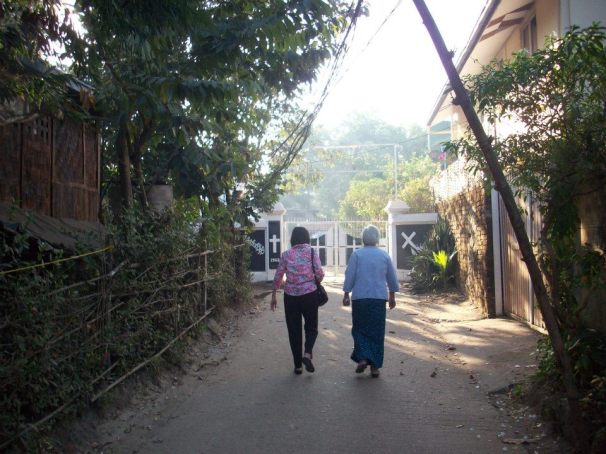
Nunu and her sister-in-law, Aunty Than, walk down the road to Zion Baptist Church. Her family once owned an immense swath of nearby land, which they fondly remember as “Zion Hill.”
While the Western empire might have charted the maps whose confines we inhabit, the spaces grafted onto page and (hi)story have also functioned to create networks of alliance and hope for those displaced by its grids:
“The personal connections some Burmese exiles have built up with their host countries’ policy, economic and intellectual circles have also facilitated the formation of extensive transnational networks of collective action, all using their host countries as a bridgehead for their struggle.”
(Egreteau 130)
The operative invisibility of diasporic alliances is charged by the mapping of nations–an aesthetic distraction–while also working against the concept of their boundaries as natural and static. My family tested the fluidity of mapped boundaries by crossing the border into Thailand without papers, then being able to make it to the States despite. This dual escape and re-rooting did not only occur via mission networks but also cross-cultural networks of benevolence, including the lending of safe harbor and silence by a Buddhist family. Furthermore, my family had already had a community of relatives, friends, and organizations in the States ready to welcome and embed their allyship—a constellation that they have continued cultivating as they help Karen families resettle in the States to this day. This network transcended essentialized notions of race and therefore allyship, proving nations to be an imagined mapping, and their margins to be active and dynamic enough to collapse the map like tears across paper.
Trinh Minh-ha writes of maps as if they are a center made of margins:
“How possible is it to undertake a process of decentralization without being made aware of the margins within the center and the centers within the margin? Without encountering marginalization from both the ruling center and the established margin? . . . This shuttling in-between frontiers is a working out of and an appeal to another sensibility, another consciousness of the condition of marginality: that in which marginality is the condition of the center.”
(216)
Again, it is in the deft movements “in-between frontiers” that a new consciousness—and new mappings of identity and legacy—might materialize. The ambiguity that the colonial gaze requires from its subjugated reflection both reifies and disrupts its image as absolute. As Bhabha surmises, “The menace of mimicry is its double vision which in disclosing the ambivalence of colonial discourse also disrupts its authority. And it is a double vision that is the result of what I’ve described as the partial representation/recognition of the colonial object” (126). Just as in storytelling, map-making can reveal the inauthenticity of authority. Through a creation of its own; the lives, stories, and realities forced to navigate the maps of empire have spoken back and created a counter-map, one which might engulf the tenuously static confines of the former. The diasporic map is a map of menace.
 A Mirage Named Myanmar
Recent Comments