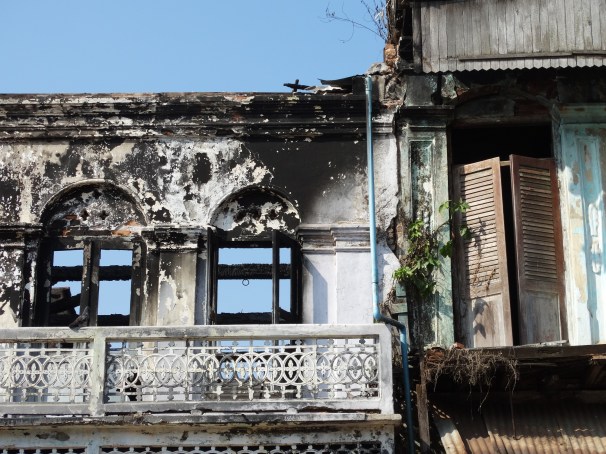
Jungle creeping through the facade of a colonial era building in Moulmein, Burma.
What does it mean to be a trick of the light? What it is like to be the process of a blink, a futile closing and reopening to rectify a moment of double-vision? Many of Nunu’s stories explore existence as an empire’s mirage—the inverted image of another’s selfhood. Like a mirage, my Karen family’s existence both depended upon and was shaped by colonialism’s ‘civilizing’ project. The colonizer’s narrative arch therefore shaped the trajectories of livelihood and survival that made my very existence possible. If I trace back the arch of my own narrative, I am then met with a complicated pattern of overlying scripts: I can perceive the ways in which my family were used by the British in order to conquer—their mythologies erased to ensure the sovereignty of another’s—yet it is also clear that past generations were uniquely dependent on the British in order to survive the mark of empire. What is also clear is that the repercussions for the Karen today, who are involved in one of the longest civil wars (disputes over the recognition of nationhood) in history, are equally fraught. On the one hand, the British catalyzed the territorial and cultural tension that has now become a trademark of the Karen existence; on the other, the Karen have become reliant on Western aid organizations and notions of democracy in order to sustain their foothold within a postcolonial borderland.
It is challenging to embody stories that speak against each other, which is why I turn to Said’s notion of counterpoint as a way of making cohesion from disarray, without abandoning tension as narrative lifeblood: “the idea of counterpoint is attractive and important in that it neither synthesizes different things easily and quickly, nor does it allow for forgetting the painful or uncomfortable memories in the past, but it keeps highlighting the irreconcilable tension among different elements, listening carefully to their voices, and exploring their peaceful, contrapuntal co-existence over time” (Magome 73). The concept of counterpoint is striking in its bold claim of ‘peaceful co-existence’ crafted from the remembering of painful experiences and the dissonance of “irreconcilable tension.” This is a crucial realization that might aid in dispelling the mirages of self and nation as cultivated by colonialism. Though the slippage or distortion of the Other’s reflection reaffirms the absolutism of the West; it is precisely because of this allowance for slippage that distortions might become new reflections, embedded as part of the mirror rather than part of its trick. Said’s concept of counterpoint is based on the traits of Western classical music, in which a polyphony of sounds co-exist and co-create thematically, so that in readings and re-readings of the cultural archive “new narratives emerge, and they become institutionalized or discursively stable entities” (51). If one’s identity as subaltern is trapped within the ‘inimitable’ blueprint of Western imperialism, then it must learn the game to change it, or at least allow for the pluralization of its strategies. I believe this is the driving force of counterpoint’s irony, which is that it is a concept derived from Western culture. From the ‘absolute’ comes a set impossibilities–and they must find new terrains to be realized into possibility.
Said’s counterpoint dispels the myth of culture as bounded and discrete, and therefore as units from which nations might be mapped:
“Culture is never just a matter of ownership, of borrowing and lending with absolute debtors and creditors, but rather of appropriations, common experiences, and interdependencies of all kinds among different cultures. This is a universal norm”
(217)
Contrapuntal reading enables me to view the multiple tellings of my grandmother’s story—their subtle frictions and fluxing nuances—not with a recolonizing refusal but with a decolonizing pride, therefore enabling a growing space for such multiplicities to be heard. In other words, though I was taught to read her stories as subaltern interruptions to a colonial narrative, I will also counter-read them as co-existent with the peaks and narrativized stride of the colonial legacy.
This next story recounts an experience that lends itself to a contrapuntal reading. I therefore hope you too will listen for not only the dominant narrative—that my grandmother’s family was attacked and robbed on their British estate—but also the reverberations of other, submerged and submerging narratives. For example, listen to the undercurrent of how an alien faith was claimed and fashioned for survival; listen for the various ways in which those displaced and re-instated by the gains and losses of another’s war experience and react to fear; and think about how the criminals culpable for inducing fear are merely pillaging the empire of their exploitation. Lastly, listen to the lilt of humor as it synchronizes the disparate narratives and characters caught in this harrowing story. From bumbling thieves, to the dramatic irony of an eldest son, the spirit of survival abides through a thematically humorous telling. The mirage of colonial presences is thus capsized by the knitting together of its fragmented realities; making space for the conquered, displaced, rebellious, and the conquerors alike to root new narratives. In other words, mimicry as storytelling creates a hybridized space within each repetition, and
“a willingness to descend into that alien territory—where I have led you—may reveal that the theoretical recognition of the split-space of enunciation may open the way to conceptualizing an international culture, based not on the exoticism or multi-culturalism of the diversity of cultures, but on the inscription and articulation of culture’s hybridity.”
(Bhabha 209)
Please step into the “alien territory” of these stories, and perhaps you will begin to perceive postcolonial legacies not as discrete canvases, but as one canvas producing multiple subjectivities, realities, hybridities, and potentialities.
 A Mirage Named Myanmar
Recent Comments