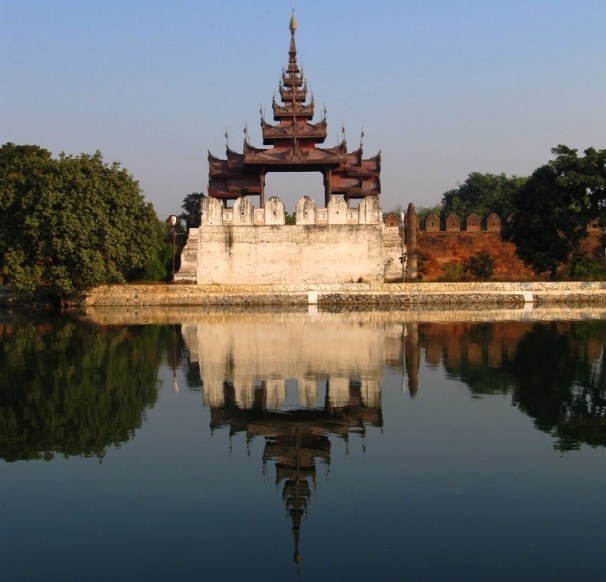
Mandalay Palace’s mirrored face, 2014.
What’s in a name? To which authority does it bend? And in so doing,
what Other’s authority does it break?
This next story is embedded in my middle name: “Dausae.” In translation from Burmese to English, it means “silver sword,” and like the shiny reflective surfaces of the sword, my name also embeds the trick of a mirror in catching (and being blinded by) the sun. It was given as a medal to my great-great-grandfather—an ethnic Karen who served as village police chief—from British officials, in recognition of his contributions to the peace and prosperity of the administration. In short: he arrested a nefarious outlaw that other ethnic administrative officials could not. The sword therefore simultaneously reflects an identity and a mirage: that my family was recognized as part of the Anglican project, and became part of their ranks; and that my family was also never recognized as truly Anglican at all:
“In a world where Homi Bhabha’s maxim—that to be anglicized is emphatically not to be English—was enforced by census categories and legal statutes, which was more real? The pantomime of daily living, with its ritual assumption of English dress, language, and etiquette by school pupils who were denied an English identity in law? Or the ephemeral realm of ‘Entertainments’, where native performances of European identities were never presented as anything more than an optical illusion?”
(Edwards 292)
Life as an ethnic member of the British administration was akin to theater—one is playing the role of another, and no matter how precisely he or she appears as the other, they will never quite become them. But the continued pageantry is crucial to enabling the grip of empire. This is not to minimize the achievements of my Karen family within the British colonial administration. As noted earlier, to have been conquered is to be offered a limited set of subjectivities, and my family merely carved its paths of survival through the spaces and scripts offered them. They encountered and reflected empire as a sword would catch the light–embedded in its radiance, rendered sightless by its white light.
But what possibilities were inscribed on the Karen legacy by the civilizing mission of the West? Why was it that the Karen, and other ethnic hill tribes of Burma participated more thoroughly, successfully, and reliably within the British empire? One of the primary modes of colonial operation has always been the maxim, divide and conquer. I see this in my family, and in their broken links to a both a Burmese and Karen heritage. The Karen legacy as ascertained today has largely been carved out of the legacy of Western missionaries in Burma, who turned to the more impressionable ethnic hill tribes after they were met with resistance from the Burman people.
Prior to its majority being converted to Christianity, the Karen were known as pluralistic in language, culture, religion, and origin (Rajah 523). Moreover, many of these benchmarks of identity were shared and hybridized across other ethnic groups. Only after the Karen and other hill tribes were adopted into the frontlines of Burma’s civilizing mission, did they become a subsidiary of the Anglo-Christian narrative, and therefore were bestowed a higher seat within the British administration. As Edwards depicts, the Karen and other converted ethnicities were “corralled and cordoned off a space outside/below European society and outside/above Burmese society” (293). The Karen operated in a hybridized and disembodied space of their own—never quite being allowed the full benefits of British citizenship despite aesthetic and nominal gestures (i.e. language, clothing, mannerisms, knightings, etc.), while also being ostracized from the predominantly Burman population. Perhaps this is why the Karen have never been able to procure the geospatial bounds of a nation since. They were not subaltern enough for postcolonial recognition, yet were not elevated enough for colonial amalgamation.
The Karen nation—and therefore the canvas of my family’s legacy—operates within a sort of no-man’s land. Their complicity with the colonial empire has forever distanced them from an ethnic origin that belongs within the Burmese narrative and has erased them from a Western narrative that mistakes forgetting for absolution. This is a difficult space to write about, let alone from:
“[the] floating buffer zone of the regional elite-subaltern, is a deviation from the ideal—the people or subaltern—which is itself defined as a difference from the elite . . . what taxonomy can fix such a space? . . . their text articulates the difficult task of rewriting its own conditions of impossibility as the conditions of its possibility”
(Spivak 285)
In other words, the voices and narratives of the Karen are doubly fraught with the “anxiety of colonial discourse” that Spurr discusses. Writing from the fault line between conquered and conqueror is already a fragmented and contradictory act; yet, what is it to write and reverberate as the very friction produced by that fault line? Can such a space, or a non-space, even be conceived of? If not, then how can it exist? Asking these questions and continually writing through this striated space—re-uttering its contradictions—is the only way to ensure that it does exist, and that therefore, I might have a place from which to tell you stories.
The story I am sharing with you is not only about a name, then, but a space that exists as two sides of a sword. Like a hyphen, the silver sword at the heart of this story allows for two different identities—two conflicting faces—to inhabit the same space and narrative. You will hear Nunu recount a family legacy that has been ingrained in generations through a symbol and an utterance, “Dausae.”
I like to think of my inheritance of this name as an inheritance of a hybridized reality, one that allows me access to a space in which the borders between narratives—both optical illusion and storied collision—become a home and a heartbeat. It bestows on me a refractive weapon of my own: “one of the most powerful weapons within the arsenal of the subaltern subject: that of displacement, disruption, ambivalence or mimicry, discursive features founded not in the closed and limited construction of a pure authentic signbut in endless and excessive transformation of the subject positions possible within the hybridized” (Griffiths 241). The more fraught with ambiguity one’s legacy is, the more potentialities exist for re-visioning both selfhood and stories. And I believe the Karen narrative, as I know it through my family’s oral histories, is therefore worth the telling—perhaps as a starting point for the re-imagining and the re-shaping of an unspoken nation.
 A Mirage Named Myanmar
Recent Comments