To tell Burma’s story is to utter a lie. This is for two reasons: First, by challenging or calling out the master narrative—that of the colonial presence—I am speaking an untruth. In other words, I am speaking against the ‘truth’ of the Western narrative. Where the spine of History arches high, I dig beneath to find its reflection as tunnel. There are many such tunnels, or sub-histories, hollowing out the bedrock of the Western narrative; but they are only excavated and displayed as inverses of its truth. As Dipesh Chakrabarty writes, “There is a peculiar way in which all these other histories tend to become variations on a master narrative that could be called ‘the history of Europe’ . . . one can only articulate subaltern positions in the name of this history…” (383). To tell a non-Western story is to therefore tell a Western story about a non-narrative. I am operating within the frame of the victors, and by writing this I am acknowledging the bounds of the frame as I rail against its presence.
Secondly, referring to Burma as a nation is to reify its existence as cultivated by the British. In other words, naming Burma—conjuring its nation-ness and bringing into stark contrast its cultural and spatial borders—requires a simultaneous historical ellipses. Such forgetting from the page “is a crucial factor in the creation of a nation, which is why progress in historical studies often constitutes a danger for [the principle] of nationality” (Renan 11). For Burma to be conceived as nation, it must first be shed of its colonized past, so that a congealment of ethnic identity and origin might take its place. But what if such totalizing perceptions had not been a part of Burma prior to British rule (at least not in the essentialized way that earmarks modern [post]colonial nations)? What if the totalizing gestures of nationhood are a response to having once had your lands and bodies totalized by others? Then, is the newly crafted nation more a recovery or a reiteration?
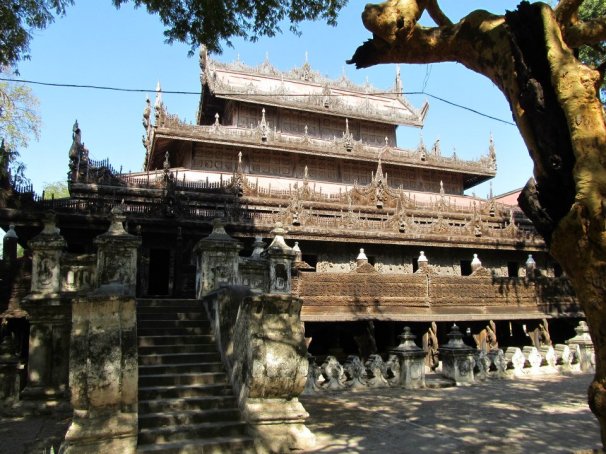
Golden Palace Monastery, Burma. Ne Win’s military regime drew claimed Buddhism at its roots, in part as a reclamation of culture and a rejection of colonial influence. This connection was distorted to garner authority through ethnic violence.
I am not saying that postcolonial nation-building is futile, I am merely stressing that origins and histories are vulnerable, slippery, and in flux; and as such, creating a stabilized identity around them can prove to be little more than a ruse. For despite Burma’s strident attempts to create a nation of authenticity and independence, it seems one of many postcolonial countries that “could only assume form, if not complete substance, by replicating the sociopolitical structures of colonial powers” (Rajah 520). Whether referring to modern-day, liberated Myanmar, or the not-so-long-ago British colony of Burma; I am in either case making an omission. To name Burma as nation is to reify Empire as origin. To name Burma as nation is to continue submerging a pre-colonial legacy that is irretrievable—and it is the irretrievability of a discrete past that must be acknowledged alongside the possibility of future geopolitical formations. Many lives can and are lost in the desperate reach of a nation towards an indelibly altered, and therefore alien, past.
My grandmother, Nunu Zan, could have been one of them, multiple times. In Nunu’s story of life in the trenches, she remembers what it was like for her family, who held a seat within the British administration, to suffer the consequences of their presence: becoming soft targets of the Japanese in WWII. The British had not fully anticipated the invasion of the Japanese, and despite the imminent risk, they chose to allow the business of empire to run as usual, offering little indication to its colonized populations of their mapped vulnerability within a greater geopolitical struggle. This ended on December 23, 1941, when the Japanese dropped its first bombs into the unaware and unprepared civilians of Rangoon: “No one had any idea what was happening . . . . under no circumstances did [the British] wish to alarm the local population. It wanted to keep people at their desks and on the docks as long as possible . . . The result was that there were no bomb shelters, no plan for clearing away the dead or ministering to the thousands of wounded, no rational plan for evacuating the city or repatriating [the stranded]” (Kamdar 90). The British had effectively built an administration of people—of colonized bodies—in its own image. And, as tenuous as a mere reflection, the colonized bodies ceased to exist as equal the moment British looked away.
Bodies slouched towards soil in survival,
bodies buried under soil in death,
bodies rendered invisible in legacy.
The families of British officials had already been sent to safety prior to the Japanese invasion, yet the ethnic families who served under the British were left to absorb the chaos and pain of a war that was not their own. As Nunu recounts:
“We didn’t know . . . We were all at school, lunchtime, and the plane came and started bombing . . . We have to bite a little cork in our mouth and stuff our ear with cotton wool. Yeah, all–right in the middle, in the school, everybody crying, running . . . After the bombing only the siren sounded, then, you know. At first, people didn’t know what happened . . . We didn’t know what happened . . . we didn’t know where to go.”
(Nunu Zan)
As you listen to this re-telling, I would like to bring to your attention two things: the repetition of ‘not knowing’, and the disintegration of frames of time and space. Her memory is fragmented, however the feeling of confoundment continually operates within the gaps between scenes, places, and faces. Geographic orientation and linear time-keeping becomes unnecessary in the wake of moment-to-moment survival—in Nunu’s story, they are treated more as roadblocks or obstacles to communication than forces of orientation. I remember repeatedly interjecting in order to gain a better idea of time and space so that I could frame it within the larger historical narrative, so that it could be traceable, fact-checkable, reputable.
But why? Whose story am I really trying to tell? And what are my expectations of that story? Who, or what, is shaping those expectations—and are they really my own? I feel as though I am digging for a story that will disrupt the Western narrative; but in order for it to be told it must be approved by the very same narrative it seeks to destroy. David Spurr writes of the “anxiety of colonial discourse” that embattles my writing:
“Is it the voice of an individual writer, the voice of institutional authority, of cultural ideology? It is all these things often at the same time. In the colonial situation as in its aftermath, this ambiguity in writing itself joins with the logical incoherence of colonial discourse to produce a rhetoric characterized by constant crisis, just as colonial rule itself continually creates its own crisis of authority.”
(11)
Welcome, reader, to a crisis. To access the stories entrenched in colonial history is to dig into the archives of “logical incoherence”: if I reveal submerged truths as new, I—as colonial subject—am only reflecting back the old establishment of truth-authorization, the Western narrative. Yet these sub-stories must continually be excavated, and I hope by writing this I might better grasp why.
There is something in the process of participating in the theater of Western academe, and using its processes to distort its own image (even when if it requires such irony as a bastion of prestige) that feels both onerously old and promisingly new. Perhaps an acceptance of the indelible Western imprint on all subaltern legacies is necessary, and must be stood upon before built away from and unmoored. It is an unwanted, un-asked for scaffold to other places—culturally and geopolitically—if we are willing to use its devices. We cannot go back, reaching for an identity distorted by time and memory, but we cannot stay here.
When you listen to Nunu’s story, I ask that you think about her months spent in trenches as the parallel experience to her months spent above ground in an estate and a system that both authorized and required a mass submersion. To be above as colonial subject, also meant having to operate from below, in a sort of existential grave–both physically as a victim of imperial war, and metaphorically, as a subject of empire. Consider my attempts to capture her stories a simultaneous act of freeing the dead, or in other words, allowing the silenced voices of the past to speak. Michael de Certeau describes the act of writing as an ironic “calming [of] the dead”: it allows the ghost-like presences of subjugated histories to “find access through writing on the condition that they remain forever silent” (11). Such ‘ghosts’ are therefore amenable to the page, as the page is their only platform of visibility and voice–as portrayed and spoken by the victors. Allowing Nunu to speak through the confines of the page splinters its authority, therefore morphing its bounds into more of a crucible than a crypt.
 A Mirage Named Myanmar
Recent Comments