What does it mean when ‘not-quite’ feels like most complete way of existing in this world?
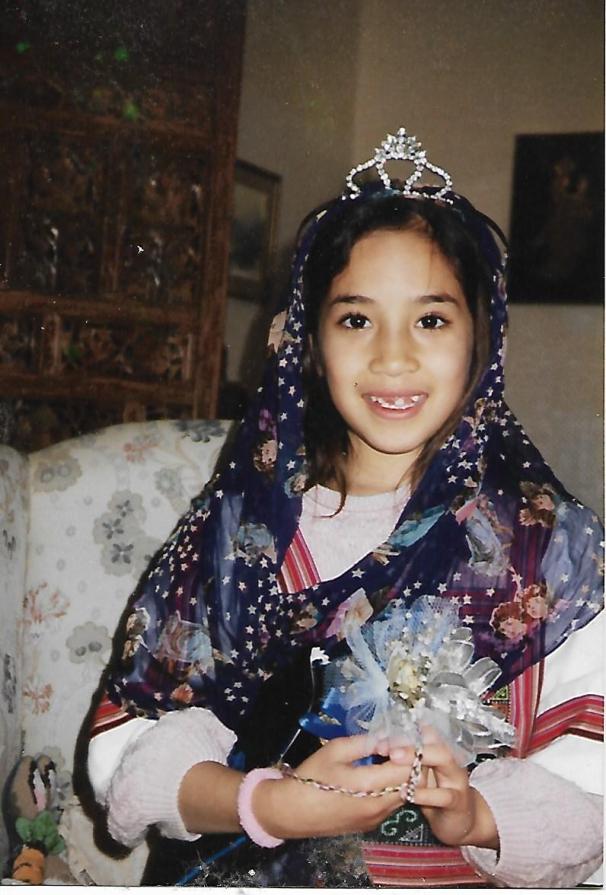
Me, circa 1994, at the Paw Family’s residence in Long Island, NY. I’m wearing a traditional Karen dress, a homecoming tiara, and what seems to be a Broadway-themed scarf.
When I was in grade school I can remember wishing my eyes were green, not unyieldingly dark pools of brown on the same color swatch as my tanned skin and even darker hair. Wait. I know what you’re thinking—and, no. No, it was not because I was approximating whiteness with beauty; at least not physical beauty, at least not quite. It was because I thought it would make my blend of features more “exotic.” I thought an eye color more alien to my features would better aestheticize the ‘hyphen’ of Burmese and German I embodied. I wanted my origins to be undetectable and untraceable. I found value in this, living as an illusion. Perhaps because I wasn’t so sure where my home, my origins, truly were. Perhaps because it seemed that my family histories had been erased from the pages of history I read in the classroom. Perhaps because the stories that hued my heritage could not be collected and archived as data—they existed in the slipperiness of a spoken word, the cadence of a voice, and the warmth of a familiar whisper. And perhaps because it was easier to mirror back this disembodied reality than to speak it.
Dennis Lee writes of the difficulty of channeling a sense of ‘home’ through speaking:
“Try to speak the words of your home and you will discover—if you are colonial—that you do not know them . . . You are left chafing at the inarticulacy of a native space which may not exist. So you shut up.”
(Lee 400)
When I look at my grandmother and my father seeking answers about this indigenous space or imagined nationhood, I fail to find more than a reflection of colonial and colonized histories. Yet, embedded in these histories are fragments of a place and a time irrevocably disrupted by empire. I am forced to piece these fragments together by tracing the narrative imprint left by the British administration—in my family’s lives and the nation of Burma writ large.
It has not slipped my mind that perhaps I have been given the benefit of not only a temporally and spatially distanced view, being yet another generation removed from life (visibly) under colonization; but also because of my privileged positioning within the very networks of colonization that still count and discount (post)colonial narratives: Western academe. Because of this, I must be vigilant about the ways in which my listening shapes the telling of my family’s stories. Frequently, before beginning a story to be recorded for this project, my grandmother would pause and ask,
“What do you want me to say again? What do you want to hear?”
I would cringe in a shell of self-awareness, but still revert to my academy-ingrained methods of creating an outline for her to follow. When I noticed she was speaking but I was not actually hearing her, I realized she was reading things off the outline practically verbatim. No, Nunu, I do not want to lose you in this project—I want this project to find you, to find, me, us. I promptly relegated the outline to the garbage bin as I silently recited Susan Jarratt’s words: “I write to show myself showing people who show me my own showing” (120). If the histories we embody are shaping our senses of selfhood, what does it mean when those histories were not our own? I cannot help but to feel an alienation from myself that is not my own, and it is in my family’s stories that I seek to find the fictions behind our existential fact. In other words, through holding up the mirror to my Karen family, I am hoping to simultaneously reflect the distortive legacies of colonialism, a distortion from which my own reflection was rendered.
Without the stories I inherited—not only embedded in my name, but my memories and perceptions—I would not be able to feel the suffocating web of colonial fictions that fuse disparate truths across bodies of lands and peoples. I wouldn’t be able to feel its vibrations whenever a new story is trapped or disentangled in its telling. For instance, earning both my BA and MA in English allowed me to perceive the abidingly violent cultural vacuum empire-building had left across the globe. No longer did the lines on a map bear an arbitrary meaning to me—no longer did they seem natural and God-given, as if the earth were map first, then spun into being. But alongside my awakening to the realities of the postcolonial world, I felt the crick and crack of fault lines jarring my sense of family narrative. For, according to my Karen father, grandfather, and grandmother, the British were the reason that my family both prospered and survived. And, it was an endowed faith in a Western God that had kept them mentally, emotionally, and perhaps even physically intact after suffering atrocities beyond my comprehension.
I believe it is my function as ‘hyphen’ to parse and re-pattern these stories that both complicate and bolster the narrative of colonialism; for “without the context of economic exploitation or social marginalization, without understanding ways of thinking and feeling interpreted through the stories of particular participants, the analysis of colonialism is suspended outside reality” (Fox 336). I do not want the hyphen to signify a lack of wholeness, but a platform to exploring stories and landscapes both physical and mythical that might render wholeness as multiple. Likewise, I aim to explore Western narrative not as a neatly bound absolute, but a composition of multiplicities in flux across the realities of multiple generations. For it is the blow of colonialism to the globe—and the continued reverberation of a collision—that created the possibility for so many subjectivities and hyphenated spaces to exist, and perhaps, to take pieces of conquered bodies back, allowing something new to emerge from the fragments.
 A Mirage Named Myanmar
Recent Comments