I must confess that I haven’t quite bought into the idea of post-colonialism. Just because something fails to be visible does not mean it no longer exists—much like attempts to make the subaltern presence disappear from the Western page has done little to negate its abiding manifestation. However, in a world that purports itself to have moved beyond the colonization of bodies and minds, one must be equipped to navigate a presence that has saturated our senses to the point of invisibility. This individual must feel at home in the contradictory space between binary absolutes and the hyphenated space between histories and names. This person must embrace hybridity as mode of being, seeing, and creating in order to trace and continually reflect the persistent ambiguities of colonialism:
“They called her half and half, mita’ y mita’, neither one or the other but a strange doubling, a deviation of nature that horrified, a work of nature inverted . . . I am the embodiment of the hieros gamos: the coming together of opposite qualities within.”
(Anzaldúa 41)
For one to write within and against the post-colonial archive, one must acknowledge the prevailing duality of ‘conqueror’ and ‘conquered,’ walking the fault lines and causing a surface-shattering quake from within.
This is to say, I believe it is the time of peri-colonialism: an urgent need to acknowledge the enclosing, surrounding, all about-ness of empire; and a call for its pervasiveness to be cut through like a second jungle of colonization—a distorted regrowth reduced to nothing, and from its roots new landscapes made. As a prefix, “peri” means “all around” and “about,” “near,” “enclosing,” “surrounding” (Merriam Webster); and “denoting the point nearest to a celestial body” (Oxford Dictionaries). Therefore a ‘peri’ awareness of colonialism is an acceptance of its inescapable gaze as well as its acceptance as absolute—the mean and measure of all things—a God whose penumbra is home to many. A second and definition of peri, as a noun, is a “graceful girl” (Merriam Webster); or in folklore, a fraught supernatural entity that is not quite an angel nor an evil spirit; or in some cases, one that exists in a purgatory, and is denied access to paradise until penance has been achieved. Therefore, to imagine peri-colonialism is to imagine not only the state of colonialism, but the state of its hybridized subjects, and the role they might play in charting new territories beyond the realm of conquest. Peri-colonialism encourages a “new archaeology of subalternism” to undergird acts of listening, writing, and re-visioning; one that “will require the recovery of faint lines that often only hint at an unfamiliar and unrecognized shape. It will require a reconstruction of the past, a new archaeology, to recover what history has forgotten; it may amount to be much more than what it has record” (Rath 103).
In this sense, the hybrid of peri-colonialism must embrace her role gracefully maneuvering the fracture lines between absolute narratives and subaltern narratives—allowing the stories of both planes to echo within its gaps, and reverberating these echoes so that the fault lines become larger, louder, unable to be ignored. Then, perhaps, the peri-colonial writer can develop a new consciousness “in which we will have to leave the opposite bank, the split between the two mortal combatants somehow healed so that we are on both shores at once and, at once, see through serpent and eagle eyes” (Anzaldúa 100). This hybrid must abandon any penance to the empire while also simultaneously refusing its inverse curse—subalternity. Instead, she must work to heal and bridge the spaces between ‘opposite banks,’ not so much to converge them as to allow each to exist, in its own right, alongside and in complication of the other. Such an act would require alternative mappings of empire that acknowledge the bounds of nation as permeable, imaginary places that have necessitated the existence of ‘supernatural,’ or hybrid beings to exist.
In this sense, peri-colonialism resonates with the narrative of the Karen, who now forcibly inhabit and resist from the geographies of the Thai-Burma border. This border separates the sacred legacy and homeland of Burma from the canvas of the democratic world—both equally unmoored from and alien to the Karen sense of nationhood. The next story I will share with you highlights the sense of being adrift that characterizes the plight of the Karen, who had allied with and were abandoned by the British; and as a result, are vehemently rejected by the Burmese. Nunu recalls a moment of post-WWII Burmese-Karen tension, in which the newly independent Burmans called for the forcible removal of the Karen from their Burma. Despite the orders to leave town by 5 a.m. the following morning, Nunu’s mother decides to rely on a dream she had, in which the boat she sought to step on drifted away:
“Maybe God was telling me, ‘Don’t go, you’re going to be drifted like that boat if you go’.”
The concept of dreaming and drifting is integral to Karen identity, for their nationhood and senses of selfhood have been largely dictated by faith in an imaginary nation, an unseen savior. This story thus explores the sort of dreamscape that the peri-colonial must inhabit: reality dictates her purgatory-like existence, yet her hybrid experiences, legacies, and imagination allows for her to dream up spaces that could one day be mapped into being.
The Karen exist on an unacknowledged map of nationhood that “resulted from a geographical imaginary and from the political ‘lawfulness’ that the two nation states (Thailand and Burma) have attempted to produce within their territories, without recognizing the cultural geographies, the nonstate maps resulting from the practices of spaces and identities, of indigenous/ethnic/forcibly displaced others in the ‘in-between spaces’”(Tangseefa 410). It is my desire that this unknown space—that which can only be realized in dream and prophecy—and more largely the alien(ized) lines of imperial borders, might one day materialize new mappings, a nation-in-diaspora and a space navigable by those who choose to drift or to dream beyond the confines of empire.
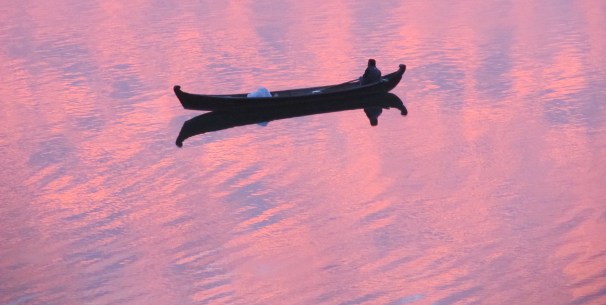
On the Irrawaddy River, a man on a gondola drifts across the gently mottled glow of a sunset.
 A Mirage Named Myanmar
Recent Comments